Smart Home Automation & Monitoring Hub
Offline ESP32-S3 smart home hub with ESP-NOW, voice control, IR learning, live camera streaming, radar wake-up & real-time energy monitoring.
- Suitable forB.Tech IoT students
- Build time3-4 weeks
- LevelBeginner
- Available atAjvika Labs, Kakinada
About this project
Modern smart home systems typically rely on cloud connectivity and internet access, which introduces latency, privacy concerns, and dependency on external infrastructure. In many real-world scenarios, reliable internet connectivity is not always available, and users still require fast, secure, and private home automation.
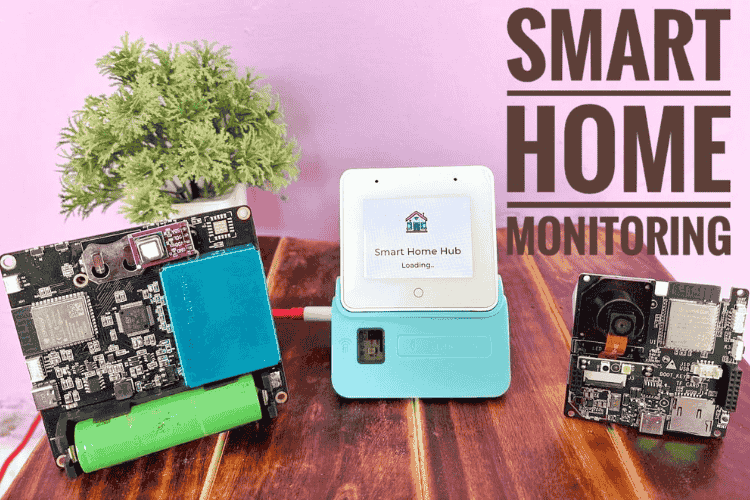
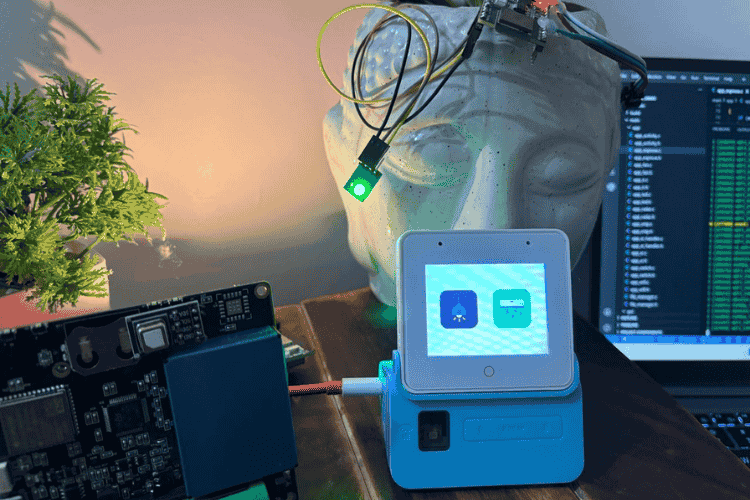
The Smart Home Automation and Monitoring Hub is a centralized smart home controller developed to manage and monitor multiple IoT devices from a single interface. This project presents a fully local, router-free smart home hub built using ESP32 devices. The entire system operates without internet connectivity, ensuring low latency, high reliability, and complete data privacy. The system is built using an ESP32-S3-BOX-3 platform and integrates voice wake-up, environmental sensing, and wireless communication using ESP-NOW and Wi-Fi/HTTPS. The device acts as the “brain” of the home, communicating with remote ESP nodes to collect indoor weather, appliance control & video surveillance while providing a touch-enabled graphical interface for real-time control and feedback.
The system supports voice-controlled appliance automation using the ESP
Speech Recognition (ESP-SR) stack. Users can control home appliancessuch as lights, air conditioners, TVs, and other IR-based devices using natural voice commands. Legacy appliances are supported through an onboard IR transmitter and learning mode, allowing the system to replace traditional remote controls.
This project was created to solve the problem of fragmented smart home devices that operate independently and require multiple apps or hubs. By combining automation, monitoring, and communication into one device, the hub provides a low-power, responsive, and scalable solution for smart homes.
1. Smart Home Hub (ESP32-S3 BOX)
The ESP32-S3 Box acts as a central controller with a touchscreen dashboard.
It integrates multiple wireless nodes and provides a unified interface for monitoring, automation and multimedia.
Touchscreen dashboard using LVGL
Speech recognition support
IR transmitter & receiver for legacy appliances
Wi-Fi + ESP-NOW hybrid communication
2. Indoor Weather Monitoring
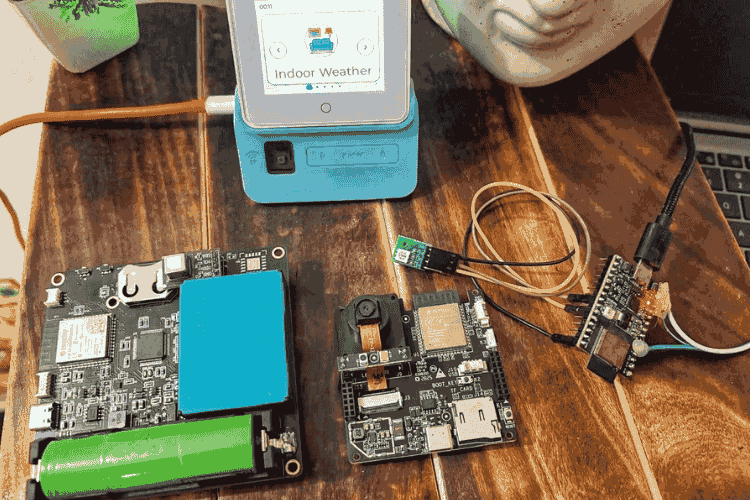
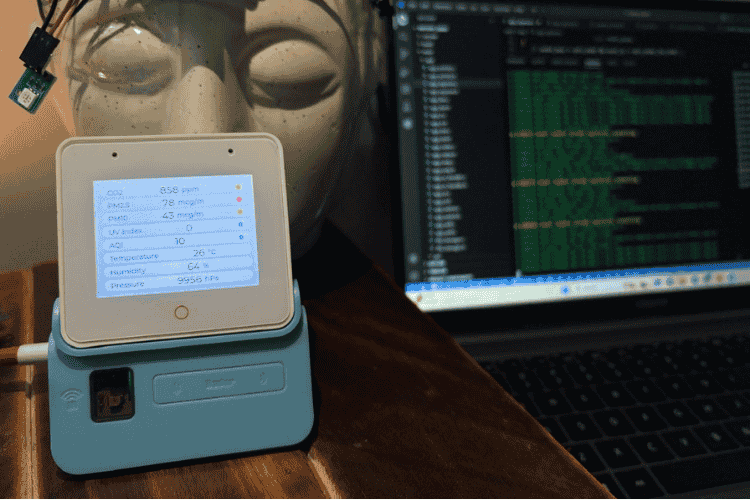
A dedicated sensor node continuously measures indoor environmental conditions and sends real-time telemetry to the hub using ESP-NOW.
Temperature & Humidity
PM2.5 & PM10 particles
Air Quality Index (AQI)
Real-time updates on dashboard
Visual air-quality indicators
Low-power wireless communication
3. Wireless Appliance Control
A relay node receives ESP-NOW commands from the hub to control electrical appliances.
Instant response (low latency ESP-NOW)
Works without internet/router
Reliable peer-to-peer communication
4. Voice + IR Control for Legacy Devices
The hub includes built-in microphone and IR transmitter to control devices that use traditional remote controls.
Voice-activated control
IR learning mode for custom remotes
Enables automation of non-smart appliances
5. Live Surveillance System
An ESP32-CAM node streams live video over HTTP, which is displayed directly on the dashboard.
Real-time monitoring
Local network streaming
6. Energy Monitoring Dashboard
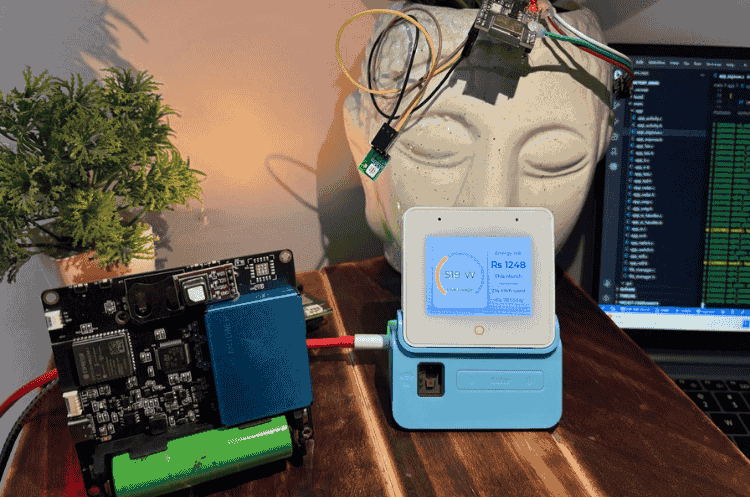
The system includes an energy usage interface showing live power consumption and estimated electricity costs.
Real-time power usage (Watts)
Monthly energy consumption (kWh)
Estimated monthly electricity bill
Daily energy cost tracking
7. Hybrid Communication Architecture
The system combines two wireless technologies for efficiency:
ESP-NOW - Low-latency device-to-device control & telemetry
Wi-Fi HTTP - High-bandwidth video streaming
This hybrid approach ensures low power consumption, high reliability, and scalability.
8. Radar Based Device Wake-Up
A radar presence sensor integrated inside the ESP32-S3 Box detects when a user approaches the device.
The display automatically wakes and activates the dashboard, enabling a touchless user experience.
ESP32S3-BOX-3, Buy from Digikey
ESP32-S3 Custom Sensor Hub
Note: For this project, a custom-designed environmental sensor node was developed using an ESP32-S3 + STM32 architecture.
This node integrates multiple air-quality and environmental sensors, including:
PM7003 – Particulate Matter Sensor (PM1.0 / PM2.5 / PM10)
LTR390 – UV & Ambient Light Sensor
BME688 – Temperature, Humidity, Pressure & Gas Sensor
The STM32 is used for sensor interfacing and data acquisition, while the ESP32-S3 handles wireless communication using ESP-NOW.
However, the system is designed to be hardware-flexible. Any ESP32-based board with compatible environmental sensors can be used to replicate the sensor node functionality.
For the surveillance module, this project uses a CamThink ESP32-S3 Camera module for live video streaming.
As an alternative, users may use the widely available standard ESP32-CAM module, which is fully compatible with the system architecture.
During this project, the following integrations and features were implemented:
Development of 5 touchscreen UI screens using LVGL
Integration of ESP-NOW wireless communication
Local HTTP video streaming & JPEG decoding
Integration of Radar-based wake-up detection
Modification of ESP-SR voice recognition & IR learning and transmission file.
Project Setup & Development
The project uses a hybrid developmentworkflow combining ESP-IDF and Arduino IDE, depending on the node functionality.
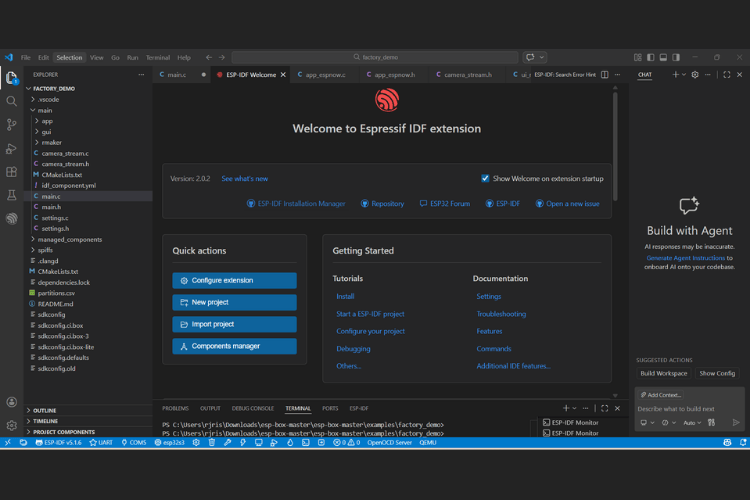
Developed using ESP-IDF inside Visual Studio Code.
ESP-IDF Extension for VS Code (V5.1.6)
Python (latest version) – required by ESP-IDF toolchain
Follow these official steps to download and setup esp-idf.
The factory demo was used as the base firmware and extended to implement custom features and multi-node integration. You can download or clone this repository to get started with demo codes.
This project primarily focuses on system integration and software architecture using ready-to-use development boards and custom PCBs. Since the modules are pre-designed and assembled, a detailed circuit schematic is not included.
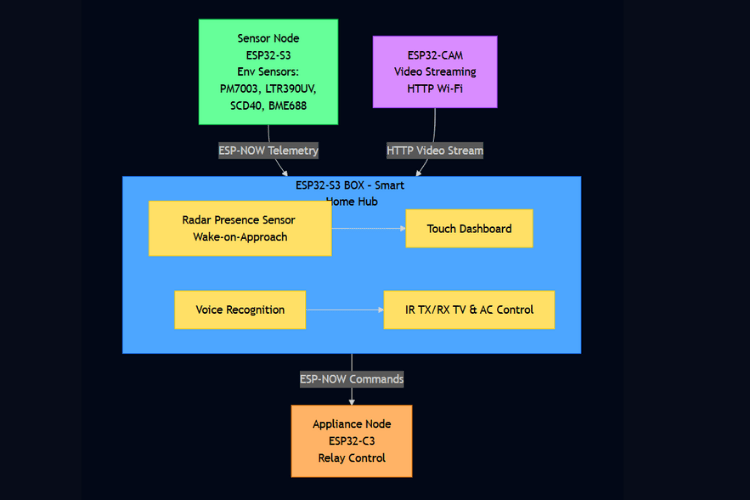
Instead, the hardware architecture is presented as a module-level block diagram, showing how the different devices communicate and interact.
UI Pages Implementation (LVGL)
The ESP32-S3 Box uses the LVGL graphics library to implement a multi-screen touchscreen dashboard.
Each feature (Weather, Devices, Camera, Energy, etc.) is implemented as an individual LVGL page.
To avoid repeating code, a base page template is created and reused by all screens.
This function creates a full-screen container that acts as the root object for every screen.
Instead of writing page setup repeatedly, every screen calls this function first.
Technologies used
Hardware components
- ESP32S3-BOX-3
- Buy fromDigikey
- ESP32-S3-CAM Module
- ESP32-C3 Dev Module
- ESP32-S3 Custom Sensor Hub
Software & tools
- Arduino IDE
- VS Code
Project demo video
What you get
- Working project / hardware kit, tested before delivery
- Complete source code with explanation
- Project demo and guidance for your viva
- Project report, PPT and IEEE paper support (on request)
Delivery & Payment
Delivery takes a minimum of two weeks from the date your inquiry is confirmed.
Payment is in two parts:
• 50% advance to start the project
• Remaining 50% before delivery
Note:
• Documentation and PPT are not included by default
• If you need documentation/PPT, it can be arranged for extra time and cost
We'll confirm the exact timeline and cost with you after reviewing your requirements.
Related IoT projects

IoT
DIY IoT Plant Watering System using Arduino
A remote plant-watering system that monitors soil moisture and lets you trigger a water pump from anywhere through the Blynk app, with LED-m...
View project
IoT
Build a smart mirror with an Arduino UNO Q
A wall-mounted smart mirror that shows the time, calendar, to-do list, room temperature/humidity and weather forecast behind a two-way glass...
View project
IoT
ESP32 Patient Health Monitor ECG SpO2 BPM Live Dashboard
Build a complete patient health monitoring system using ESP32 with AD8232 ECG sensor, MAX30102 pulse oximeter, BME280 and live web dashboard...
View project
IoT
IoT AC Energy Meter with PZEM-004T and ESP32 WebServer
Build an IoT-based AC energy meter using ESP32 and PZEM-004T to measure voltage, current, power, frequency and energy with live web dashboar...
View project