


Intelligent Farming System Using IoT and Edge AI
This project leverages IoT and Edge AI to create an Intelligent Farming System designed to enhance farming practices. It automates critical tasks like irrigation and animal detection while optimizing water usage, soil monitoring and environmental control. This solution supports farmers in boosting productivity and meeting modern agricultural demands sustainably.
- Suitable forB.Tech AI students
- Build time4-6 weeks
- LevelAdvanced
- Available atAjvika Labs, Kakinada
About this project
My goal is to mainly deploy this in an agricultural field or greenhouse to automate tasks like irrigation by effectively monitoring different parameters such as soil moisture, humidity, temperature, etc. In addition to this, I’ll train the voice recognition model of Sipeed Maixduino to detect the presence of animals in the area (specifically bird and cat for my use case).
By doing so, we collect data for sustainable agriculture and effective resource management. Furthermore, the initiative intends to meet the present agricultural industry's demands:
\"Lower the environmental impact of farming while simultaneously producing more food for the increasing global population.\"
The concept is achievable, but the project's complexity lies in making everything scalable, flexible, and reasonably priced. This will help farmers to boost their production and income by many times while using the same resources!!
The Intelligent Farming System combines IoT and Edge AI to address critical agricultural challenges, including resource efficiency, unpredictable weather, and wildlife interference. By offering real-time monitoring and control over irrigation, water usage, and soil conditions, it empowers farmers to increase productivity sustainably while reducing waste. The system’s design, including battery power and anti-theft features, makes it versatile for rural deployment, even in off-grid areas. This solution transforms farming into a data-driven practice, promoting food security and resilience against climate impacts. Gain hands-on experience through beginner to advanced artificial intelligence projects.
In my creative approach, I always prefer to record all of my ideas in a notebook based on my online research. After that, I select ideas based on their practicality, time required to implement them, and the cost.
During my research on this topic, I prepared a list of features that can be incorporated into the Intelligent Farming System Using IoT and Edge AI.
I divided it in two parts, design choices and smart agriculture components. Design Choices refer to the engineering and architectural decisions made to ensure reliability, flexibility, and ease of use in real-world agricultural settings while on the other hand, Smart Agriculture Components refer to the advanced functionalities that leverage AI and IoT to enhance farming efficiency.
Dedicated data processing node on the cloud or a different computer (say Raspberry Pi) for processing AI.
Dedicated data processing node on the cloud or a different computer (say Raspberry Pi) for processing AI.
Powering the complete system using a battery.
Powering the complete system using a battery.
IP-rated enclosure design.
IP-rated enclosure design.
Some kind of “Emergency response” feature so that the data will never get lost in case of any failure.
Some kind of “Emergency response” feature so that the data will never get lost in case of any failure.
SD card for storing the data locally.
SD card for storing the data locally.
A real-time IoT dashboard (preferably custom-made and running locally) that can be used to monitor and manually control everything.
A real-time IoT dashboard (preferably custom-made and running locally) that can be used to monitor and manually control everything.
Integrated LCD screen so that we can monitor key parameters without opening the dashboard.
Integrated LCD screen so that we can monitor key parameters without opening the dashboard.
Industry-standard protocol used for seamless integration.
Industry-standard protocol used for seamless integration.
Flexible input supply requirements.
Flexible input supply requirements.
Integrated SMPS so that it can be plugged directly into an AC 230V outlet.
Integrated SMPS so that it can be plugged directly into an AC 230V outlet.
Can be easily tailored as a “custom solution” for any farm.
Can be easily tailored as a “custom solution” for any farm.
Smart agriculture components
NPK monitoring in soil.
NPK monitoring in soil.
Soil moisture level monitoring.
Soil moisture level monitoring.
Voice recognition-based Livestock health monitoring.
Voice recognition-based Livestock health monitoring.
Voice recognition-based animals and bird detection.
Voice recognition-based animals and bird detection.
Agricultural drones. (Similar to ESP32-based drone designed by circuit digest itself!!)
Agricultural drones. (Similar to ESP32-based drone designed by circuit digest itself!!)
AI-based weed detection.
AI-based weed detection.
AI-based crop health monitoring.
AI-based crop health monitoring.
Automatic pest detection.
Automatic pest detection.
AI disease detection.
AI disease detection.
API-based weather monitoring to predict weather conditions like droughts and storms.
API-based weather monitoring to predict weather conditions like droughts and storms.
Water usage monitoring.
Water usage monitoring.
Even though most of these ideas are possible, it is quite hard to implement all of them at once due to time and cost constraints. So, I have shortlisted some of them that will go into this project.
Powering the complete system using a battery.
Powering the complete system using a battery.
Some kind of “Emergency response” feature so that the data will never get lost in case of any failure.
Some kind of “Emergency response” feature so that the data will never get lost in case of any failure.
Flexible input supply requirements.
Technologies used
Hardware components
- Raspberry Pi
- USB Camera
- Pi Camera
- Jetson Nano
Software & tools
- Python
- TensorFlow
- OpenCV
- Jupyter Notebook
- Google Colab
Project demo video
What you get
- Working project / hardware kit, tested before delivery
- Complete source code with explanation
- Project demo and guidance for your viva
- Project report, PPT and IEEE paper support (on request)
Related AI projects

ESP32 CAM Object Detection using Edge Impulse TinyML
Deploy a custom TinyML object detection model trained on Edge Impulse on ESP32-CAM to identify objects like vegetables, gestures or products...
View project
ESP32 Real-Time Face Recognition Attendance System
Build a face recognition attendance system using ESP32-CAM that automatically logs attendance with timestamp to Firebase when a registered f...
View project
C++ Programming Language
C++ Programming Language — a beginner AI project built with HTML5, CSS3, JavaScript, complete with design details, implementation steps and...
View project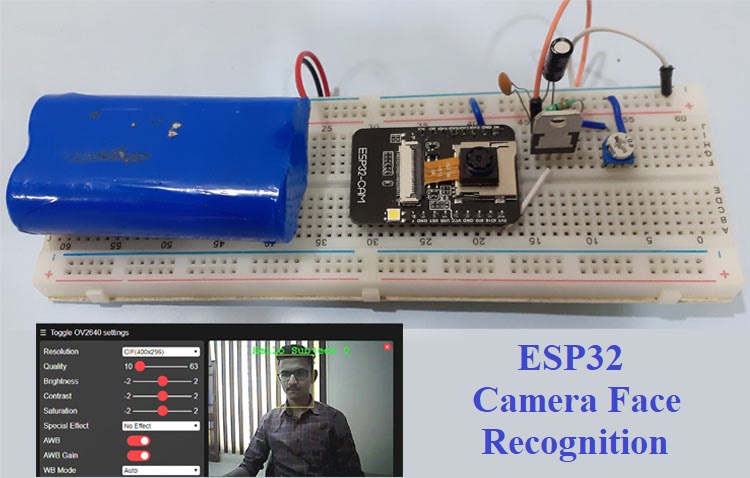
How to use ESP32 Camera Module for Video Streaming and Face Recognition
In this project, we are going to build a Face Recognition System using ESP32-CAM which will also work as an ESP32-CAM Security system by rec...
View project