
ESP32 Smart Irrigation Controller with Soil and Weather Data
Build a smart irrigation controller using ESP32 that uses real soil moisture data and OpenWeatherMap API to intelligently schedule watering.
- Suitable forB.Tech IoT students
- Build time4-6 weeks
- LevelAdvanced
- Available atAjvika Labs, Kakinada
About this project
Intelligent irrigation controller uses ESP32 with inputs: capacitive soil moisture sensor, DHT22 for local temperature/humidity, and OpenWeatherMap API for weather forecast. Controller skips watering if rain is forecasted in next 24 hours. Watering schedule: configurable zones (6 zones via 6-relay module), daily/weekly schedules per zone, manual trigger from web interface. Smart mode: calculates ET (evapotranspiration) using Penman-Monteith equation considering temperature, humidity, wind speed, solar radiation from weather API. Logs all watering events to SD card. Web dashboard: zone status, soil moisture per zone, forecast widget, schedule calendar, manual controls. Push notifications via Pushover app when watering starts/stops or system error. Offline mode: if WiFi/API unavailable, falls back to time-based schedule with soil moisture override. Libraries: HTTPClient, ArduinoJson, RTC library, SD, WiFi, ESPAsyncWebServer.
Detailed Project Description
ESP32 Smart Irrigation Controller with Soil and Weather Data automates watering / feeding based on real sensor data instead of fixed timers, saving water and effort while keeping conditions stable.
How It Works
1. Sensors measure the relevant conditions (soil moisture, water level, pH, temperature).
2. The controller compares readings with set-points and decides when to run the pump, valve or feeder.
3. Actions and readings are logged and can be viewed/overridden from a phone or web page.
4. Schedules and thresholds are configurable without re-flashing the firmware.
Key Components and Their Role
- ESP32: dual-core Wi-Fi + Bluetooth microcontroller that runs the firmware, reads the sensors and hosts the network connection.
- DHT22: digital temperature and humidity sensor with better accuracy than DHT11.
- Relay module: electrically isolated switch that lets the controller turn AC/DC loads on and off.
- Soil moisture sensor: capacitive probe that measures water content of soil.
- microSD card module: storage for logs, audio or images over SPI.
- Solar panel: renewable power source for off-grid operation.
Implementation Steps
1. Collect the components and study each module's datasheet (pin-out, voltage, interface).
2. Wire the circuit on a breadboard following the pin mapping; power sensors from the correct rail (3.3 V / 5 V).
3. Install Arduino IDE, OpenWeatherMap API, ArduinoJson and the required libraries; flash a minimal test sketch for each module separately.
4. Write the main firmware: read sensors → process → drive outputs / send data.
5. Configure network or cloud credentials and test communication end-to-end.
6. Calibrate thresholds, add error handling (reconnect, sensor time-out) and run a long-duration test.
7. Finalise on a PCB / enclosure and document wiring, code and results.
Key Features
- Sensor-based automation
- Manual override
- Configurable thresholds
- Remote monitoring
Expected Output
On completion the student will have automatic pump/feeder operation with a log of every action and reading.
Deliverables
- Complete source code with comments
- Circuit diagram and pin mapping
- Project report with screenshots and results
- Demonstration-ready build
Technologies used
Hardware components
- ESP32 DevKit
- 6-Channel Relay Module
- 6x Capacitive Soil Sensors
- DHT22 Sensor
- MicroSD Card Module
- 220V Solenoid Valves
Software & tools
- Arduino IDE
- OpenWeatherMap API
- ArduinoJson
- ESPAsyncWebServer
What you get
- Working project / hardware kit, tested before delivery
- Complete source code with explanation
- Project demo and guidance for your viva
- Project report, PPT and IEEE paper support (on request)
Delivery & Payment
Delivery takes a minimum of two weeks from the date your inquiry is confirmed.
Payment is in two parts:
• 50% advance to start the project
• Remaining 50% before delivery
Note:
• Documentation and PPT are not included by default
• If you need documentation/PPT, it can be arranged for extra time and cost
We'll confirm the exact timeline and cost with you after reviewing your requirements.
Related IoT projects

IoT
DIY IoT Plant Watering System using Arduino
A remote plant-watering system that monitors soil moisture and lets you trigger a water pump from anywhere through the Blynk app, with LED-m...
View project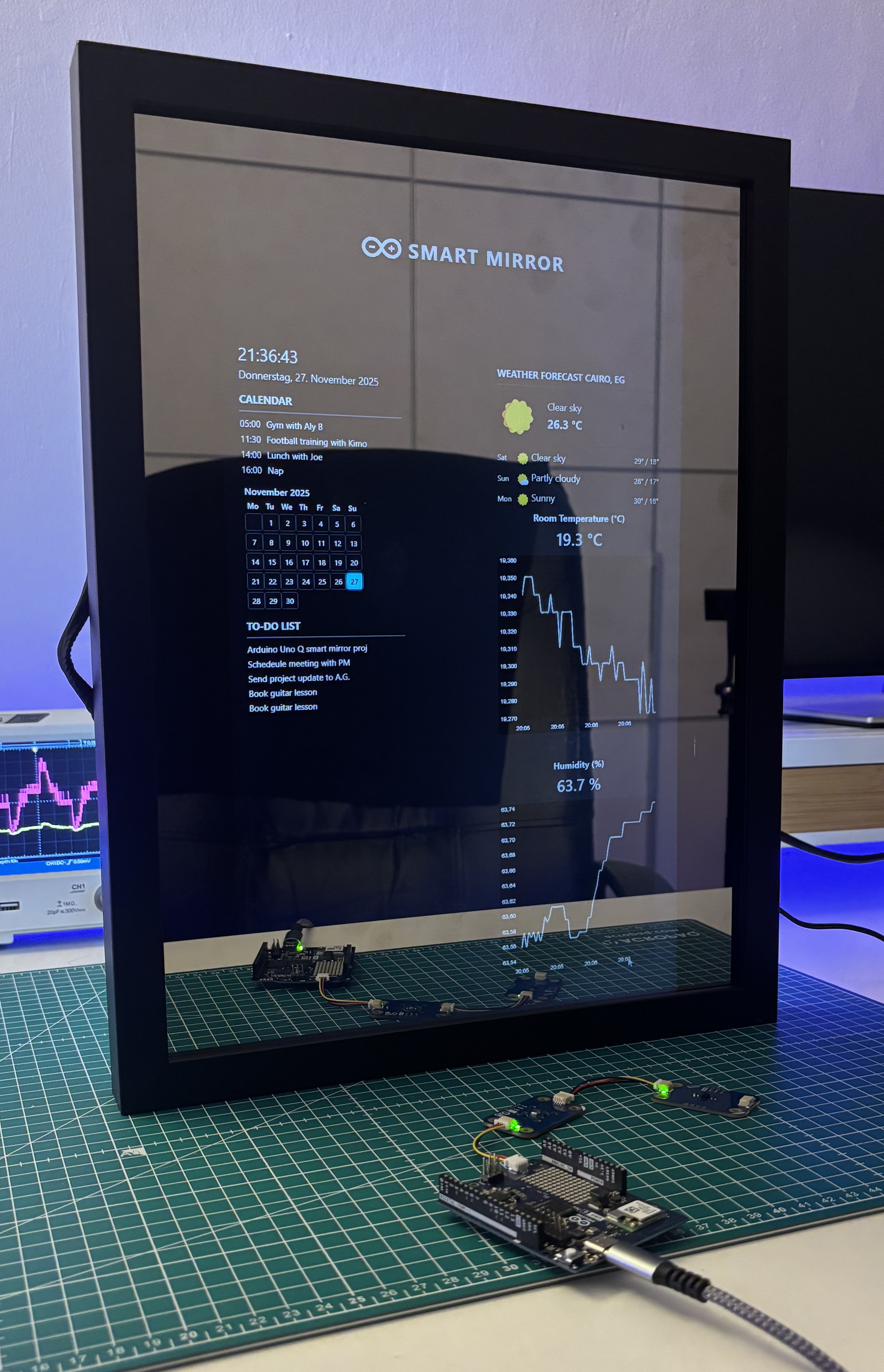
IoT
Build a smart mirror with an Arduino UNO Q
A wall-mounted smart mirror that shows the time, calendar, to-do list, room temperature/humidity and weather forecast behind a two-way glass...
View project
IoT
ESP32 Patient Health Monitor ECG SpO2 BPM Live Dashboard
Build a complete patient health monitoring system using ESP32 with AD8232 ECG sensor, MAX30102 pulse oximeter, BME280 and live web dashboard...
View project
IoT
IoT AC Energy Meter with PZEM-004T and ESP32 WebServer
Build an IoT-based AC energy meter using ESP32 and PZEM-004T to measure voltage, current, power, frequency and energy with live web dashboar...
View project