


AI-Based Air Quality Index Monitoring and Suggestion System
Develop a portable device using Sipeed Maixduino with sensors and MLP neural network to read pollutants, predict AQI, and display real-time health suggestions, enhancing proactive air quality measures.
- Suitable forB.Tech AI students
- Build time4-6 weeks
- LevelAdvanced
- Available atAjvika Labs, Kakinada
About this project
To see the full demonstration video, click on the YouTube Video below.
1. LCD (16x2 I2C Display)
Working : This LCD uses the I2C communication protocol, which simplifies wiring by using only two data pins (SDA and SCL) to transmit data. It displays characters and numbers in two rows of sixteen columns.
Working : This LCD uses the I2C communication protocol, which simplifies wiring by using only two data pins (SDA and SCL) to transmit data. It displays characters and numbers in two rows of sixteen columns.
Need : The LCD displays real-time AQI values and predictions. It provides a user-friendly way to view sensor data and AQI category information directly from the device.
Need : The LCD displays real-time AQI values and predictions. It provides a user-friendly way to view sensor data and AQI category information directly from the device.
2. MQ Sensors (Analog Gas Sensors)
Working : The MQ-7 sensor detects carbon monoxide (CO) in the air. It outputs an analog signal corresponding to the concentration of CO gas.
Working : The MQ-7 sensor detects carbon monoxide (CO) in the air. It outputs an analog signal corresponding to the concentration of CO gas.
Need : CO levels are a crucial part of air quality assessment. Monitoring CO helps detect harmful levels of pollution, particularly in indoor and urban environments.
Need : CO levels are a crucial part of air quality assessment. Monitoring CO helps detect harmful levels of pollution, particularly in indoor and urban environments.
MQ-135 (Air Quality Sensor) :
Working : The MQ-135 measures air quality by detecting gases like NH3, NOx, alcohol, benzene, smoke, and CO2. It outputs an analog signal proportional to the gas concentration.
Working : The MQ-135 measures air quality by detecting gases like NH3, NOx, alcohol, benzene, smoke, and CO2. It outputs an analog signal proportional to the gas concentration.
Need : As a versatile air quality sensor, the MQ-135 helps in gauging general pollution levels, essential for estimating the overall AQI.
Need : As a versatile air quality sensor, the MQ-135 helps in gauging general pollution levels, essential for estimating the overall AQI.
MQ-136 (H2S Sensor) :
Working : The MQ-136 detects hydrogen sulfide (H2S) gas, outputting an analog signal related to its concentration.
Working : The MQ-136 detects hydrogen sulfide (H2S) gas, outputting an analog signal related to its concentration.
Need : H2S is a toxic gas often found near industrial areas. Monitoring it helps provide a more comprehensive air quality analysis.
Need : H2S is a toxic gas often found near industrial areas. Monitoring it helps provide a more comprehensive air quality analysis.
MQ-4 (Methane Sensor) :
Working : The MQ-4 detects methane (CH4) gas. It produces an analog signal based on the concentration of methane in the air.
Working : The MQ-4 detects methane (CH4) gas. It produces an analog signal based on the concentration of methane in the air.
Need : Methane is a flammable gas and a contributor to the greenhouse effect. Monitoring its levels is important in both air quality assessment and safety.
Need : Methane is a flammable gas and a contributor to the greenhouse effect. Monitoring its levels is important in both air quality assessment and safety.
MQ-131 (Ozone Sensor) :
Working : The MQ-131 sensor detects ozone (O3) gas, providing an analog output proportional to the concentration.
Working : The MQ-131 sensor detects ozone (O3) gas, providing an analog output proportional to the concentration.
Need : Ozone levels are important for AQI, as high ground-level ozone can cause respiratory issues and harm vegetation.
Need : Ozone levels are important for AQI, as high ground-level ozone can cause respiratory issues and harm vegetation.
3. Nova PM Sensor (PMS5003)
Working : The PMS5003 measures particulate matter (PM) levels, specifically PM2.5 and PM10. It uses laser scattering to detect particle concentration in the air and communicates data via UART (TX/RX pins).
Working : The PMS5003 measures particulate matter (PM) levels, specifically PM2.5 and PM10. It uses laser scattering to detect particle concentration in the air and communicates data via UART (TX/RX pins).
Need : Particulate matter (PM) is a primary factor in calculating AQI. PM2.5 and PM10, in particular, are important indicators of air pollution, as these fine particles can penetrate the respiratory system and impact health.
Need : Particulate matter (PM) is a primary factor in calculating AQI. PM2.5 and PM10, in particular, are important indicators of air pollution, as these fine particles can penetrate the respiratory system and impact health.
3. CIRCUIT CONNECTION
LCD (16x2 I2C Display) :
Connect the SDA pin to (SDA) on the Maixduino.
Connect the SDA pin to (SDA) on the Maixduino.
Connect the SCL pin to (SCL) on the Maixduino.
Connect the SCL pin to (SCL) on the Maixduino.
Connect GND to GND.
Connect GND to GND.
MQ Sensors (Analog Sensors) :
Connect the MQ-7 (CO Sensor) to A0 (IO33) on the Maixduino.
Connect the MQ-7 (CO Sensor) to A0 (IO33) on the Maixduino.
Connect the MQ-135 (Air Quality Sensor) to A1 (IO32) on the Maixduino.
Connect the MQ-135 (Air Quality Sensor) to A1 (IO32) on the Maixduino.
Connect the MQ-136 (H2S Sensor) to A2 (IO35) on the Maixduino.
Connect the MQ-136 (H2S Sensor) to A2 (IO35) on the Maixduino.
Connect the MQ-4 (Methane Sensor) to A3 (IO34) on the Maixduino.
Connect the MQ-4 (Methane Sensor) to A3 (IO34) on the Maixduino.
Connect the MQ-131 (Ozone Sensor) to A4 (IO39) on the Maixduino.
Connect the MQ-131 (Ozone Sensor) to A4 (IO39) on the Maixduino.
For each MQ sensor, connect VCC to 5V and GND to GND on the Maixduino.
For each MQ sensor, connect VCC to 5V and GND to GND on the Maixduino.
Nova PM Sensor (PMS5003) :
Connect the TX pin of the PMS5003 to IO5 (TX1) on the Maixduino.
Technologies used
Hardware components
- Raspberry Pi
- USB Camera
- Pi Camera
- Jetson Nano
Software & tools
- Python
- TensorFlow
- OpenCV
- Jupyter Notebook
- Google Colab
Project demo video
What you get
- Working project / hardware kit, tested before delivery
- Complete source code with explanation
- Project demo and guidance for your viva
- Project report, PPT and IEEE paper support (on request)
Related AI projects

ESP32 CAM Object Detection using Edge Impulse TinyML
Deploy a custom TinyML object detection model trained on Edge Impulse on ESP32-CAM to identify objects like vegetables, gestures or products...
View project
ESP32 Real-Time Face Recognition Attendance System
Build a face recognition attendance system using ESP32-CAM that automatically logs attendance with timestamp to Firebase when a registered f...
View project
C++ Programming Language
C++ Programming Language — a beginner AI project built with HTML5, CSS3, JavaScript, complete with design details, implementation steps and...
View project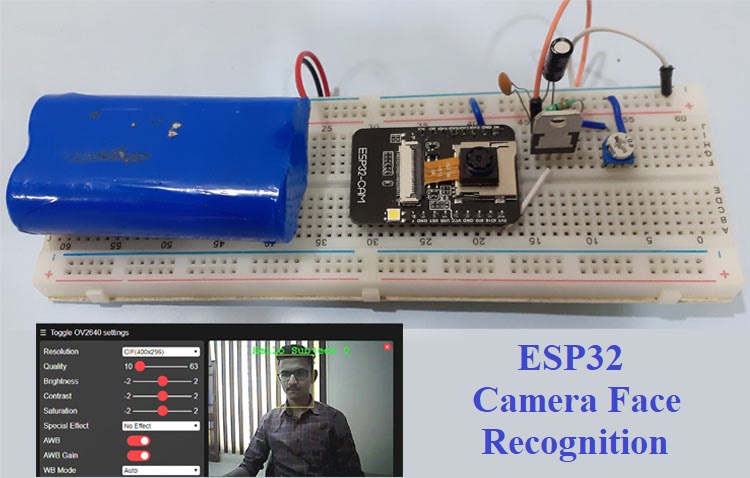
How to use ESP32 Camera Module for Video Streaming and Face Recognition
In this project, we are going to build a Face Recognition System using ESP32-CAM which will also work as an ESP32-CAM Security system by rec...
View project