Smarter Arm Control For Robots
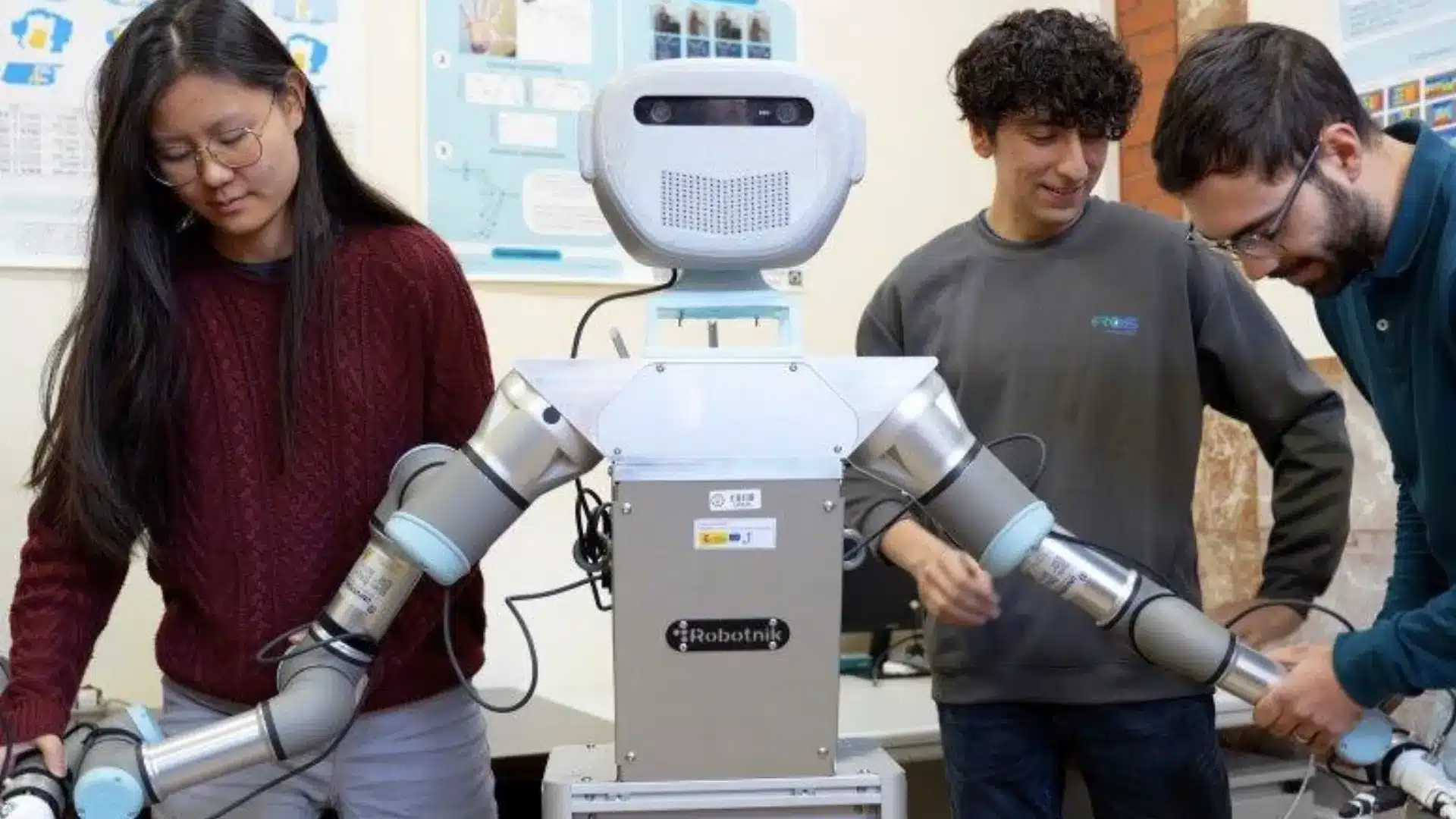
Robots could soon do daily home tasks on their own. A new method helps them move both arms together and adjust when things change.
- Suitable forB.Tech & M.Tech Embedded students
- Build time3-4 weeks
- LevelAdvanced
- Available atAjvika Labs, Kakinada
About this project
Robots could soon do daily home tasks on their own. A new method helps them move both arms together and adjust when things change.
Researchers at Universidad Carlos III de Madrid have developed a method that allows robots to coordinate their arms more flexibly by combining observational learning with communication between the robot’s limbs. The approach improves how service robots adapt their movements when conditions change.
The method is designed to help robots handle daily household tasks such as setting and clearing the table, ironing, and cleaning the kitchen. By enabling both arms to share information during a task, the system supports smoother and more stable motion.
Teaching robots to perform everyday activities remains a central challenge in robotics. Traditional programming requires defining each movement in detail, often through thousands of lines of code. Imitation learning offers a different path. Instead of coding every step, a human demonstrates the task. This can be done by physically guiding the robot’s arm or by recording the action for the robot to observe.
Through this process, the robot learns to perform tasks such as pouring water or organizing objects on a shelf. However, direct copying is not enough. If a robot learns to grasp a bottle at a fixed position and the bottle is moved slightly, a system based only on repetition may fail because it repeats the original trajectory.
The new technique addresses this limitation by enabling learned movements to adjust when the target changes. The motion adapts smoothly, similar to a rubber band shifting shape while keeping its structure. This allows the robot to reach a new position while preserving key aspects of the task, such as keeping a bottle upright to prevent spilling.
By focusing on adaptation rather than rigid repetition, the method moves service robots closer to operating reliably in home environments where object positions and conditions often vary.
SHARE YOUR THOUGHTS & COMMENTS Register or Login to leave a comment.
Smart Speed Monitoring System For Road Safety
Real-Time Face Tracking Using Raspberry Pi 4 Versus Raspberry Pi 5 With Hailo-8L
High-Voltage Capacitor Discharger
Real-time Web-based Home Automation
World’s Smallest Open-Source LoRa + GPS Module for Wearables and IoT (Only 3cm!)
Smallest Spy Video Streaming Camera
Wirelessly Control Multiple AC Appliances with Web Interface
Blockchain Black Box For Drones
Integrated EV Drive For Higher Power Density
Hybrid Cooling System Targets Power Efficiency
Electric Field Tunes Heat Transport In Solids
Ultra-Low-Loss Isolated Current Sensor
STMicroelectronics has Introduced First Automotive Microcontroller With built-in AI Acceleration
Samsung Launched 200MP Image Sensor Called ISOCELL HP5
Aeva Introduced 4D LiDAR Sensor for Physical AI Systems
DIY: Audio Signal–Controlled LED Display Using LM3914
State Reduction In Sequential Circuits
Make Your Own Musical Temperature Alarm
Buck Converter vs Linear Voltage Regulator
Ultra-Compact RGB LED For Space-Constrained Designs
Compact Varistors For High Surge Protection
Gold Plated Reed Relays For High Voltage Systems
28nm Automotive MCU For Zonal E/E Architectures
DSP / Audio Firmware Engineer (Intern) At Chordy.ai In Bengaluru
JOB: System Engineer At General Electric In Chennai
JOB: Analog Layout Engineer At Accenture In Bengaluru
JOB: HVDC HMI Engineer At Quest Global In Bengaluru
Circuit Design Calculators for Engineers and Students
Broadside Coupled Stripline Impedance Calculator
Edge Coupled Stripline Impedance Calculator
Asymmetric Stripline Impedance Calculator
Researchers at Universidad Carlos III de Madrid have developed a method that allows robots to coordinate their arms more flexibly by combining observational learning with communication between the robot’s limbs. The approach improves how service robots adapt their movements when conditions change.
The method is designed to help robots handle daily household tasks such as setting and clearing the table, ironing, and cleaning the kitchen. By enabling both arms to share information during a task, the system supports smoother and more stable motion.
Teaching robots to perform everyday activities remains a central challenge in robotics. Traditional programming requires defining each movement in detail, often through thousands of lines of code. Imitation learning offers a different path. Instead of coding every step, a human demonstrates the task. This can be done by physically guiding the robot’s arm or by recording the action for the robot to observe.
Through this process, the robot learns to perform tasks such as pouring water or organizing objects on a shelf. However, direct copying is not enough. If a robot learns to grasp a bottle at a fixed position and the bottle is moved slightly, a system based only on repetition may fail because it repeats the original trajectory.
The new technique addresses this limitation by enabling learned movements to adjust when the target changes. The motion adapts smoothly, similar to a rubber band shifting shape while keeping its structure. This allows the robot to reach a new position while preserving key aspects of the task, such as keeping a bottle upright to prevent spilling.
By focusing on adaptation rather than rigid repetition, the method moves service robots closer to operating reliably in home environments where object positions and conditions often vary.
SHARE YOUR THOUGHTS & COMMENTS Register or Login to leave a comment.
Smart Speed Monitoring System For Road Safety
Real-Time Face Tracking Using Raspberry Pi 4 Versus Raspberry Pi 5 With Hailo-8L
High-Voltage Capacitor Discharger
Real-time Web-based Home Automation
World’s Smallest Open-Source LoRa + GPS Module for Wearables and IoT (Only 3cm!)
Smallest Spy Video Streaming Camera
Wirelessly Control Multiple AC Appliances with Web Interface
Blockchain Black Box For Drones
Integrated EV Drive For Higher Power Density
Hybrid Cooling System Targets Power Efficiency
Electric Field Tunes Heat Transport In Solids
Ultra-Low-Loss Isolated Current Sensor
STMicroelectronics has Introduced First Automotive Microcontroller With built-in AI Acceleration
Samsung Launched 200MP Image Sensor Called ISOCELL HP5
Aeva Introduced 4D LiDAR Sensor for Physical AI Systems
DIY: Audio Signal–Controlled LED Display Using LM3914
State Reduction In Sequential Circuits
Make Your Own Musical Temperature Alarm
Buck Converter vs Linear Voltage Regulator
Ultra-Compact RGB LED For Space-Constrained Designs
Compact Varistors For High Surge Protection
Gold Plated Reed Relays For High Voltage Systems
28nm Automotive MCU For Zonal E/E Architectures
DSP / Audio Firmware Engineer (Intern) At Chordy.ai In Bengaluru
JOB: System Engineer At General Electric In Chennai
JOB: Analog Layout Engineer At Accenture In Bengaluru
JOB: HVDC HMI Engineer At Quest Global In Bengaluru
Circuit Design Calculators for Engineers and Students
Broadside Coupled Stripline Impedance Calculator
Edge Coupled Stripline Impedance Calculator
Asymmetric Stripline Impedance Calculator
Technologies used
Hardware components
- Raspberry Pi
- Relay
- LED
- Sensor
- Module
- Capacitor
- Camera
- GPS
- LoRa
- RF
What you get
- Working project / hardware kit, tested before delivery
- Complete source code with explanation
- Project demo and guidance for your viva
- Project report, PPT and IEEE paper support (on request)
Delivery & Payment
Delivery takes a minimum of two weeks from the date your inquiry is confirmed.
Payment is in two parts:
• 50% advance to start the project
• Remaining 50% before delivery
Note:
• Documentation and PPT are not included by default
• If you need documentation/PPT, it can be arranged for extra time and cost
We'll confirm the exact timeline and cost with you after reviewing your requirements.
Related Embedded projects

Embedded
ESP32 Fingerprint Attendance System with Live Web Dashboard
Build a biometric attendance system using ESP32 with AS608 fingerprint sensor that logs attendance with timestamp to web dashboard and Googl...
View project
Embedded
Mars Rover Robot Replica using ESP32 CAM and Arduino
Build a Mars Rover robot replica using ESP32-CAM and Arduino with a rocker-bogie suspension system, live video streaming, and smartphone app...
View project
Embedded
ESP32 CAN Bus Tutorial Interfacing MCP2515 with ESP32
Learn CAN bus communication with ESP32 and MCP2515 CAN controller to send and receive data in automotive and industrial applications.
View project
Embedded
ESP32 MP3 Music Player with SD Card and I2S Amplifier
Build a standalone ESP32 MP3 music player that reads audio from SD card and outputs high-quality audio via I2S DAC amplifier with web contro...
View project