
Interfacing the A7672S 4G LTE GNSS Module with Arduino
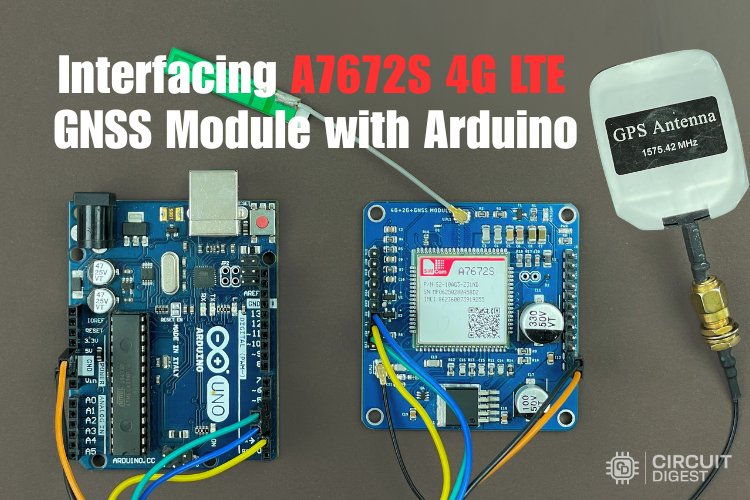
Learn how to use the A7672S 4G LTE GNSS module with Arduino for GPS tracking and IoT communication. This guide covers pinout, interfacing, AT commands, and HTTPS data upload. Ideal for mobile projects like smart vehicles, remote monitors, and asset tracking, the A7672S offers reliable cellular connectivity and precise location data without Wi-Fi dependency
- Suitable forB.Tech Embedded students
- Build time3-4 weeks
- LevelBeginner
- Available atAjvika Labs, Kakinada
About this project
How to interface A7672S with Arduino projects
Complete A7672S AT commands reference guide
Building a real-world GPS tracker using A7672S
Understanding A7672S variants and their differences
Implementing SMS, calls, and HTTPS requests
Working with 4G LTE cellular connectivity in IoT projects
What makes the A7672S GSM module particularly appealing for Indian developers is its comprehensive network compatibility. This 4G GSM module was specifically designed for India, supporting all major cellular networks including Jio, Airtel, and VI. This extensive network support ensures reliable connectivity across India, from metropolitan cities to remote villages, making it an ideal choice for nationwide IoT deployments.
Whether you're building a GPS tracker, a smart vehicle system, or a remote environmental monitor, the A7672S Arduino module provides reliable connectivity and precise location data in a compact, all-in-one solution. If you are interested in more cost-effective 2G GSM modules, you can check out, how to use the SIM800L GSM module with Arduino.
The A7672 series has multiple variants with different capabilities. This tutorial covers the A7672S-FASE, which includes built-in GNSS for location tracking. Other variants like A7672S-LASC and A7672S-LASE do not have GNSS support. While this tutorial applies to all A7672S variants, the GNSS-related AT commands only work with A7672S-FASE modules.
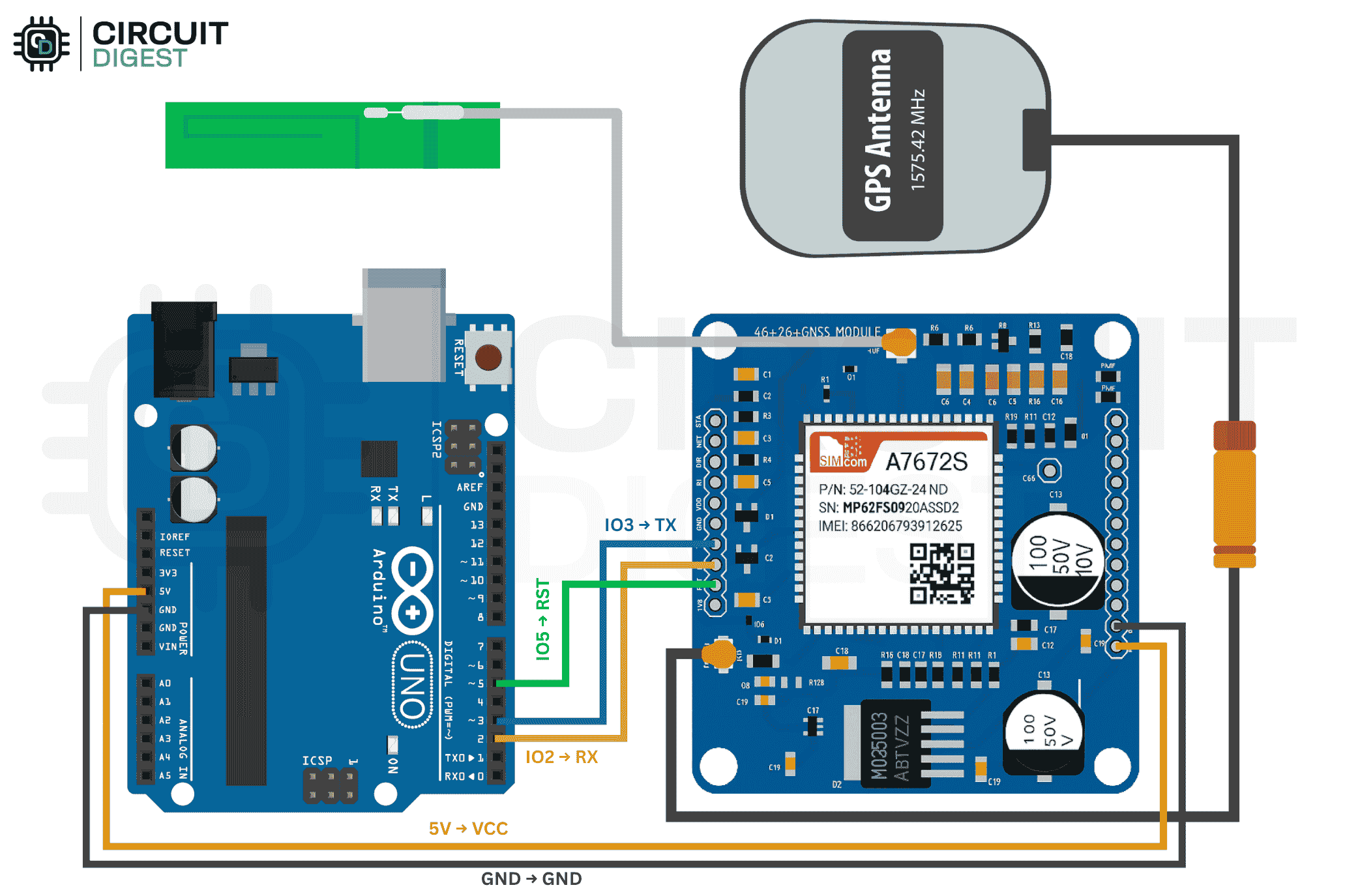
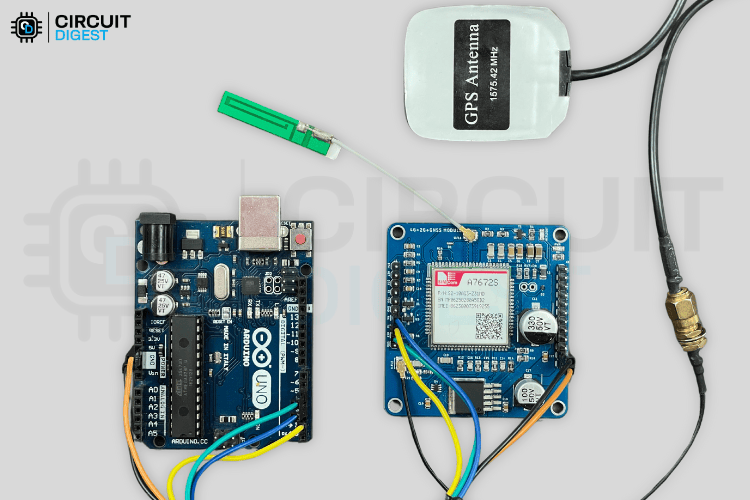
Arduino Circuit Diagram
AT commands of the A7672S Module
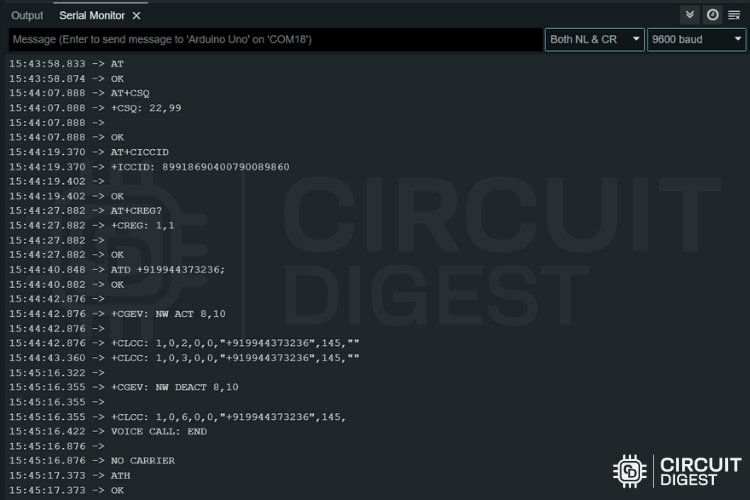
└ AT Commands for Making a Voice Call
└ AT Commands for Sending Message
└ AT Commands for Reading GNSS (GPS) Data
└ AT Commands for HTTPS Request in A7672S
GPS Tracking Demo with A7672S Module and GeoLinker
Frequently Asked Questions - A7672S Module
└ What's the difference between A7672S-FASE and A7672S-LASE?
└ Can A7672S work with Arduino Uno?
└ Which SIM cards work with A7672S in India?
GitHub Repository for A7672S
Projects using GSM Module
A7672S 4G LTE GNSS Module
The A7672S module combines 4G LTE cellular communication with GNSS (Global Navigation Satellite System, like GPS, BeiDou etc) positioning in a single Arduino-compatible package, making it ideal for remote IoT projects requiring both internet connectivity and location tracking.
Key Features of the A7672S Module
Understanding the A7672S features is crucial for selecting the right cellular module for your project. Here are the key capabilities that make the A7672S Arduino module stand out:
⇒ 4G LTE Connectivity: Supports high-speed cellular internet, allowing your project to send and receive data over the mobile network without Wi-Fi.
⇒ Integrated GNSS Support: Works with GPS, GLONASS, BeiDou, and Galileo satellite systems for accurate and fast location tracking.
⇒ SMS and Voice Call Capability: Can send and receive SMS messages, and even make voice calls—just like a basic mobile phone.
⇒ Arduino-Compatible Interface (UART): Easily connects with Arduino and other microcontrollers via serial communication (TX/RX pins).
⇒ Multiple Protocol Support: Supports TCP/IP, HTTP, FTP, and MQTT protocols, useful for connecting to web servers, cloud platforms, or IoT dashboards.
⇒ Low Power Consumption: Designed for energy-efficient operation, making it suitable for battery-powered devices.
⇒ Compact All-in-One Design: Combines GSM (for mobile network) and GNSS (for GPS) into a single module, saving space and reducing wiring complexity.
⇒ Global Network Support: Works with various LTE bands, so it’s compatible with mobile networks in many countries.
⇒ Real-Time Clock (RTC) Built-in: Useful for timestamping data even without an external RTC module.
The A7672S module is perfect for projects like GPS trackers, remote data loggers, smart farming devices, and any application that needs reliable internet and precise location, even in places where Wi-Fi can't reach.
A7672S 4G LTE GNSS Module Specifications
The A7672S specifications show its versatility in power requirements and operating conditions. The module uses the MIC29302 voltage regulator to provide a stable 3.9V output, allowing flexible power input options for various Arduino projects. This means you can power it with anything from 5V to 12V, making it compatible with common power supplies or USB adapters.
Battery Input Voltage
Operating Temperature
If you’re using a lithium battery, it supports voltages between 3.4V and 4.2V—perfect for standard Li-ion or LiPo cells. If you're using something like an Arduino Uno that operates on 5V logic, you might typically need a level shifter to safely connect the two. However, since this module has a built-in level shifter circuit, no external shifter is required.
On average, the module draws around 500 mA to 1A of current, but during startup, it can spike up to 3 amps. So, a good and stable power supply is essential.
It’s also robust enough for extreme environments, operating reliably in temperatures from -40°C to 85°C, and it can be safely stored up to 90°C. This makes it a solid choice for outdoor and mobile projects.
Next, let’s have a look at the pinouts.
A7672S 4G LTE GNSS Module Pinout
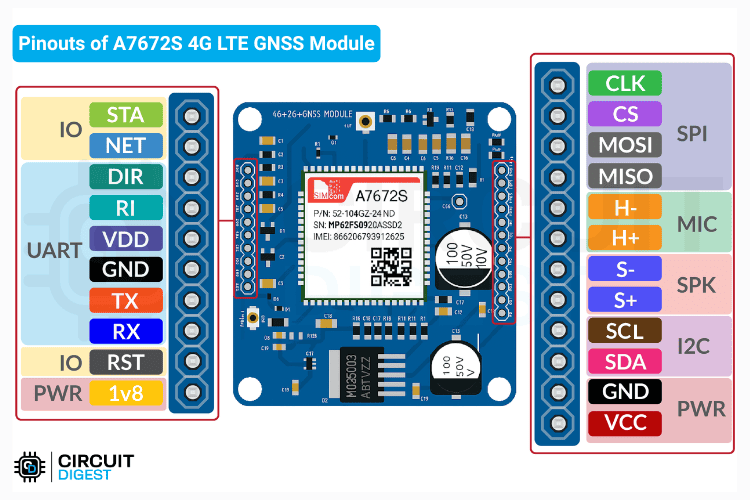
The A7672S module comes with a variety of pins that support multiple communication interfaces and functions, making it versatile for different types of projects. Below you can see the pinout image of the A7672S Module.
STA - Module status indication.
NET - Network Registration status indication.
DTR - UART DTE Ready.
RI - UART Ring Indicator.
VDD - High Reference Voltage for Level Shifter.
TX - UART Transmitter.
RST - System Reset (Active HIGH).
1V8 - 1.8v 50mA Output Voltage for Level Conversion..
Starting with the status and control pins, STA indicates the module's current status (such as power or activity), while NET shows the network registration status—great for visual feedback using LEDs. The RST pin is used to reset the module and is active high, meaning it triggers a reset when pulled high.
CS - SPI Chip Select.
MOSI - SPI Master Out Slave In.
MISO - SPI Master In Slave Out.
H- - Microphone (-ve).
H+ - Microphone (+ve).
SCL - I2C Serial Clock.
SDA - I2C Serial Data.
VCC - Main Input Voltage (5v to 12v, 3A).
For serial communication, the module includes TX and RX, which are used for transmitting and receiving data over UART. Supporting pins like DTR indicate when the host is ready for communication, and RI acts as a ring indicator to notify of incoming calls or messages. VDD provides a high reference voltage input for level shifting when connecting to different logic levels, and 1V8 gives a stable 1.8V output (up to 50mA) that can be used for logic level conversion.
Powering the module is straightforward: VCC is the main input pin accepting 5V to 12V, and it’s recommended to use a power source capable of supplying at least 3A. The module also includes two GND pins for grounding the circuit.
If you're using I2C communication, SDA and SCL are provided for data and clock lines, allowing easy integration with I2C sensors and peripherals.
For audio support, the module includes a built-in interface for connecting external audio devices: S+ and S- are used for connecting a speaker, while H+ and H- are for connecting a microphone, making it possible to build voice call or alert-based systems.
Lastly, for SPI communication, the module features four dedicated pins: MISO, MOSI, CS, and CLK, allowing fast data transfer and compatibility with SPI-based sensors, displays, or memory devices.
With this rich set of interfaces, the A7672S module is capable of handling everything from basic UART communication to full audio and sensor-based applications. Remember, if you're a beginner, you only need to use the UART and power pins; that's already more than enough to get started. Don’t confuse yourself with all the rest.
A7672S 4G LTE GNSS Module Hardware Overview
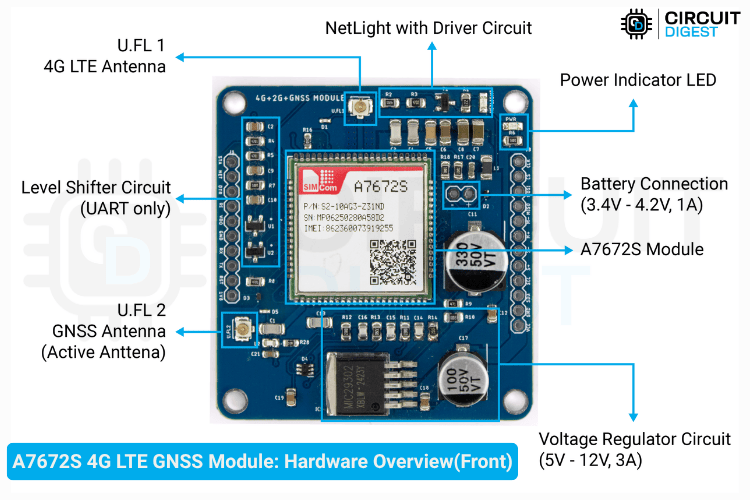
This section will help you clearly understand the hardware layout of the A7672S development board. Keep in mind that multiple manufacturers produce breakout boards for the A7672S module. While the physical layout, features, and component placement may vary, the core circuitry remains essentially the same.
Below is the version used in our tutorial,
The LDO (Low Dropout Regulator) visible in the bottom-right corner of the board is part of the onboard voltage regulation circuit. It efficiently steps down the input voltage (ranging from 5V to 12V) to a stable 3.9V, which is the required operating voltage for the A7672S module.
Surrounding resistors and capacitors act as filtering components to ensure clean power delivery. This is especially important because cellular modules are sensitive to noise on the power lines, which can negatively impact RF performance and signal stability.
The board also includes a dedicated battery input terminal (3.4V–4.2V, 1A), designed for connecting a Li-ion or LiPo battery. This battery input can be used either as a backup power source in case of primary power loss or as the main supply for portable or low-power applications.
The board includes a built-in level shifter circuit that ensures safe UART communication with microcontrollers operating at different logic voltages (e.g., 3.3V or 5V). This eliminates the need for external level converters, simplifying integration with most Arduino boards and other MCUs.
The A7672S module itself is the central processing unit that handles both 4G LTE cellular communication and GNSS positioning. It integrates the baseband processor, RF frontend, and power management functions in a compact form factor.
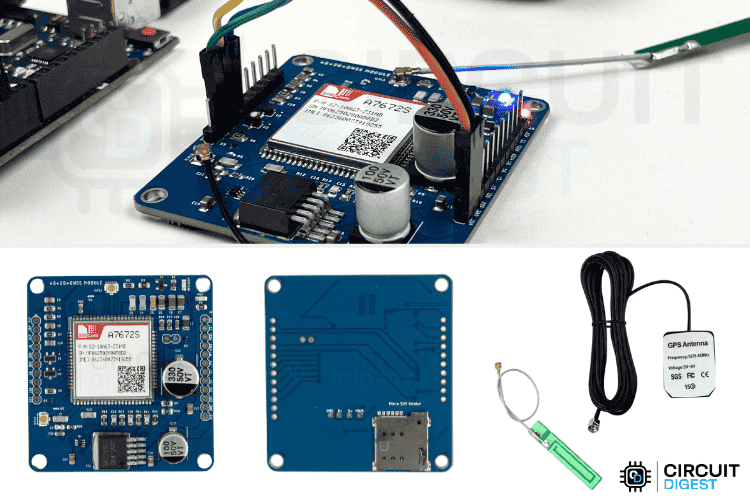
The antenna connections are critical - U.FL1 connects to the 4G LTE antenna for cellular communication, while U.FL2 connects to the GNSS antenna ( Active Antenna) for GPS/GLONASS/BeiDou positioning.
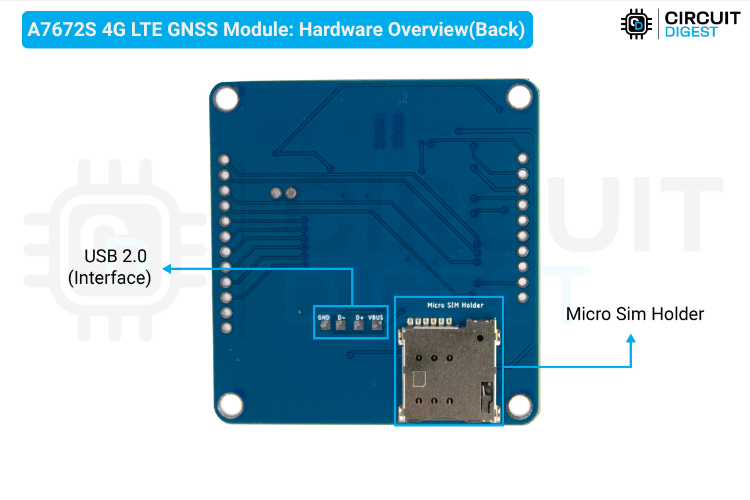
On the back, there is a Micro SIM card slot for inserting your mobile network SIM, allowing the module to register on the 4G network and access cellular services. The USB 2.0 interface provides both data communication and firmware update capabilities.
Technologies used
Hardware components
- Arduino
- LED
- Sensor
- Module
- Board
- Speaker
- Microphone
- GPS
- GSM
- SIM800
- Battery
What you get
- Working project / hardware kit, tested before delivery
- Complete source code with explanation
- Project demo and guidance for your viva
- Project report, PPT and IEEE paper support (on request)
Related Embedded projects

ESP32 Fingerprint Attendance System with Live Web Dashboard
Build a biometric attendance system using ESP32 with AS608 fingerprint sensor that logs attendance with timestamp to web dashboard and Googl...
View project
Mars Rover Robot Replica using ESP32 CAM and Arduino
Build a Mars Rover robot replica using ESP32-CAM and Arduino with a rocker-bogie suspension system, live video streaming, and smartphone app...
View project
ESP32 CAN Bus Tutorial Interfacing MCP2515 with ESP32
Learn CAN bus communication with ESP32 and MCP2515 CAN controller to send and receive data in automotive and industrial applications.
View project
ESP32 MP3 Music Player with SD Card and I2S Amplifier
Build a standalone ESP32 MP3 music player that reads audio from SD card and outputs high-quality audio via I2S DAC amplifier with web contro...
View project