
How To Electronics | Engineering Projects & Tutorials
Explore Electronics Engineering through articles, projects & circuits in Embedded, Arduino, IoT, Power, Analog, Digital & Audio domains.
- Suitable forB.Tech/Diploma ESP32/IoT students
- Build time1-2 weeks
- LevelIntermediate
- Available atAjvika Labs, Kakinada
About this project
555 Timer Projects
Dark/Light Detector using 555 Timer & LDR – Electronics Mini Project
Mamtaz Alam
February 2, 2025
Project Overview
How To Electronics | Engineering Projects & Tutorials is an intermediate-level ESP32/IoT project designed for B.Tech and Diploma students. Explore Electronics Engineering through articles, projects & circuits in Embedded, Arduino, IoT, Power, Analog, Digital & Audio domains.
Objectives
- Understand the problem statement and define clear functional requirements for the system.
- Select, interface and calibrate the required hardware modules and verify each block individually.
- Design and implement the complete solution using the selected technology stack.
- Test the implementation, document the results, and prepare a working demonstration.
Hardware Components
- LDR
Software and Tools
- Arduino IDE
Working Principle and Implementation
The system is built around LDR which acts as the main controller. Input modules and sensors are connected to the controller, the firmware reads and processes the data, and the results are used to drive the outputs, display information or communicate with a connected application or dashboard. Each stage — power supply, wiring, firmware upload and testing — is covered step by step so the project can be reproduced reliably.
Applications
- Academic mini/major project submission for B.Tech and Diploma (ESP32/IoT).
- Base platform that can be extended with additional features for real-world use.
- Hands-on practice with ESP32/IoT.
Learning Outcomes
- Practical understanding of ESP32/IoT.
- End-to-end project workflow: requirement analysis, design, implementation and testing.
- Documentation and presentation of a complete engineering project.
Project Details
- Domain: ESP32/IoT
- Level: B.Tech and Diploma
- Difficulty: Intermediate
- Estimated Duration: 1-2 weeks
Detailed Project Description
How To Electronics | Engineering Projects & Tutorials is a structured learning module: it explains the concept, shows correct syntax, walks through worked examples and finishes with practice problems and their solutions.
How It Works
1. The concept is introduced with its purpose and where it is used.
2. Syntax and rules are presented with short, runnable examples.
3. Common mistakes and edge cases are highlighted.
4. Practice questions with solutions consolidate the learning.
Implementation Steps
1. Set up the runtime and editor and confirm a hello-world program runs.
2. Study the concept definition and its syntax rules.
3. Type and run every example; change values to see how the output changes.
4. Work through the common-mistake cases and understand the error messages.
5. Solve the practice questions without looking at the solutions, then compare.
6. Apply the concept inside a small mini-project to consolidate it.
Key Features
- Concept explanation
- Runnable code examples
- Common pitfalls
- Practice questions with solutions
Expected Output
On completion the student will have a set of working examples and solved exercises the learner can run and modify.
Deliverables
- Runnable example programs
- Solved practice questions
- Summary notes of key rules and pitfalls
Hardware components
- LDR
Software & tools
- Arduino IDE
What you get
- Working project / hardware kit, tested before delivery
- Complete source code with explanation
- Project demo and guidance for your viva
- Project report, PPT and IEEE paper support (on request)
Delivery & Payment
Delivery takes a minimum of two weeks from the date your inquiry is confirmed.
Payment is in two parts:
• 50% advance to start the project
• Remaining 50% before delivery
Note:
• Documentation and PPT are not included by default
• If you need documentation/PPT, it can be arranged for extra time and cost
We'll confirm the exact timeline and cost with you after reviewing your requirements.
Related ESP32/IoT projects

ESP32/IoT
IoT Based ECG Monitoring with AD8232 ECG Sensor & ESP32
IoT Based ECG Monitoring with AD8232 ECG Sensor & ESP32 using online IoT Cloud platform Ubidots. Interface Nodemcu ESP8266/ESP32 with AD8232...
View project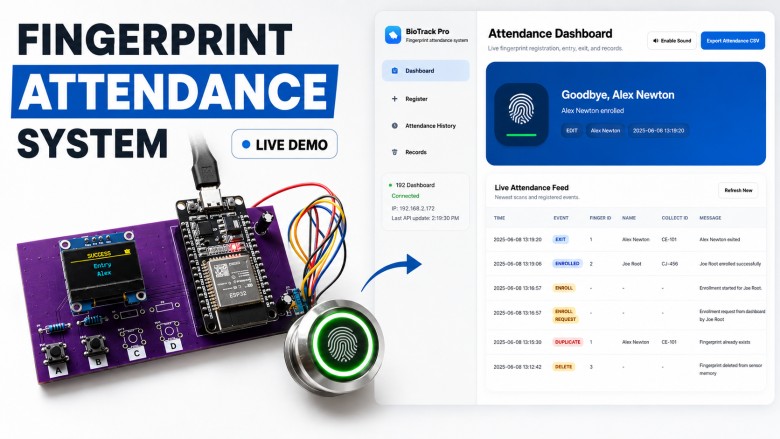
ESP32/IoT
ESP32 Fingerprint Attendance System with Live Web Dashboard
Build a fingerprint biometric attendance system using ESP32, fingerprint sensor, OLED display, and a professional web dashboard with C++ Cod...
View project
ESP32/IoT
IoT AC Energy Meter with PZEM-004T & ESP32 WebServer
IoT based AC Energy Meter with PZEM-004T & ESP32 WebServer to display Voltage, Current, Power, Energy, Frequency, Power Factor on Web page
View project
ESP32/IoT
IoT Smart Electricity Energy Meter with ESP32 & Blynk 2.0
Build an IoT-based Smart Electricity Energy Meter with ESP32 & Blynk 2.0 App & measure voltage, current, power & total energy consumed onlin...
View project