Computer Vision Guided RC Car
Self-driving cars that use computer vision to detect obstacles in their path and do waypoint navigation are being actively developed by companies worldwide.
- Suitable forB.Tech Embedded students
- Build time3-4 weeks
- LevelAdvanced
- Available atAjvika Labs, Kakinada
About this project
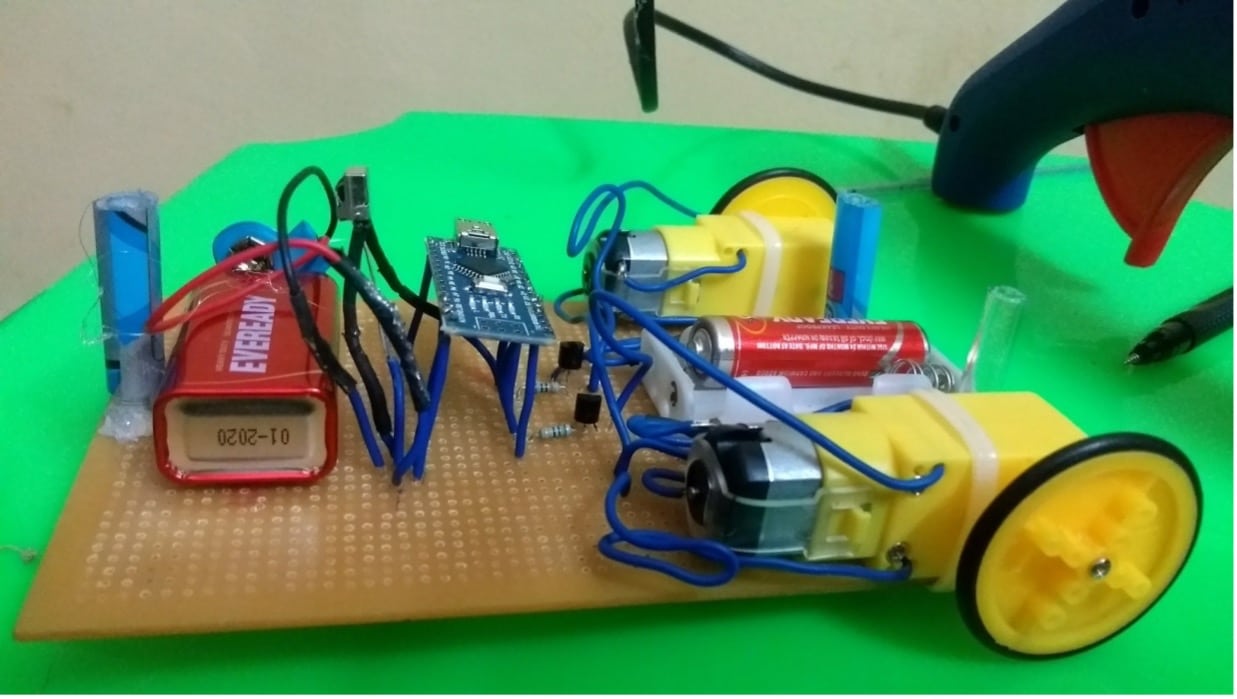
Self-driving cars that use computer vision to detect the presence of obstacles in their path and to do waypoint navigation are being actively developed by various companies around the world. The objective of this project is to develop a small set-up in which a student may implement various algorithms and test them iteratively. This project consists of the car, the IR communication link and image processing software on a laptop. A toy car is made from two DC geared motors mounted on a perforated board. The car turns using differential drive and receives signals from the computer using an IR receiver. An Arduino Nano is used to decode the received IR signals and controls the two DC motors. The IR signals can be given by the IR transmitter board connected to laptop or a normal TV remote control. A fixed overhead camera mounted with a top down view of the field acquires images that is transferred to the linux laptop through USB. The laptop running python with openCV libraries is used to do the image processing. In the current version, the python programme detects the location and orientation of the car with respect to the target and guides the car towards the target. This python programme can be upgraded with various advanced algorithms without major modification to the hardware. The Linux laptop communicates with RC car using IR transmitter (IR led) and receiver VS1838. The IR transmitter is made using an Arduino Uno mounted on a perforated board connected to the laptop with a USB cable. The toy car contains the IR receiver, also interfaced to the Arduino Uno, which drives the car. The car shown has two 9V geared DC motor wheels which are powered by two 1.5V AA batteries in series. The power to the motor is given through BC547 transistors. BC 547 is a NPN general purpose transistor. It is commonly used in audio amplifiers and signal processing circuits. In this application, the transistor is used as a low side switch. The VS1838B IR receiver is used to receive commands from a TV remote control or the transmitter connected to the laptop. It is compatible with common IR remote control data formats. The widely used IRremote.h Arduino library is used to decode the received IR signals and convert them to integers that can then be acted upon.
Technologies used
Project demo video
What you get
- Working project / hardware kit, tested before delivery
- Complete source code with explanation
- Project demo and guidance for your viva
- Project report, PPT and IEEE paper support (on request)
Delivery & Payment
Delivery takes a minimum of two weeks from the date your inquiry is confirmed.
Payment is in two parts:
• 50% advance to start the project
• Remaining 50% before delivery
Note:
• Documentation and PPT are not included by default
• If you need documentation/PPT, it can be arranged for extra time and cost
We'll confirm the exact timeline and cost with you after reviewing your requirements.
Related Embedded projects

Embedded
ESP32 Fingerprint Attendance System with Live Web Dashboard
Build a biometric attendance system using ESP32 with AS608 fingerprint sensor that logs attendance with timestamp to web dashboard and Googl...
View project
Embedded
Mars Rover Robot Replica using ESP32 CAM and Arduino
Build a Mars Rover robot replica using ESP32-CAM and Arduino with a rocker-bogie suspension system, live video streaming, and smartphone app...
View project
Embedded
ESP32 CAN Bus Tutorial Interfacing MCP2515 with ESP32
Learn CAN bus communication with ESP32 and MCP2515 CAN controller to send and receive data in automotive and industrial applications.
View project
Embedded
ESP32 MP3 Music Player with SD Card and I2S Amplifier
Build a standalone ESP32 MP3 music player that reads audio from SD card and outputs high-quality audio via I2S DAC amplifier with web contro...
View project