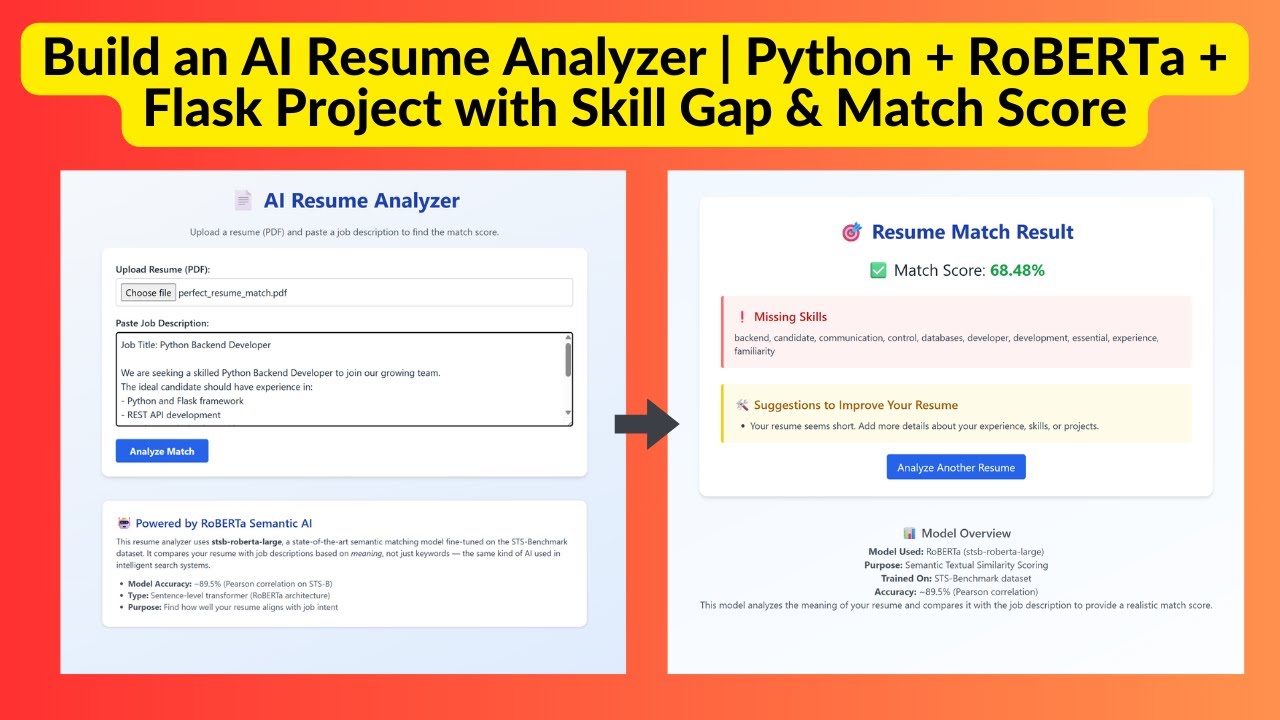
AI Resume Analyzer Using RoBERTa – Match Your Resume to Job Descriptions with Skill Gap Analysis
In today's job market, resumes need to be tailored to each job. This AI Resume Analyzer automates that process using semantic matching, allowing job seekers to upload their resume and see how well it matches a given job description — just like a recruiter might do using an ATS (Applicant Tracking System). What This Project
- Suitable forB.Tech AI/ML students
- Build time3-4 weeks
- LevelBeginner
- Available atAjvika Labs, Kakinada
About this project
AI Resume Analyzer
automates that process using
semantic matching
, allowing job seekers to upload their resume and see how well it matches a given job description — just like a recruiter might do using an ATS (Applicant Tracking System).
What This Project Does
✅ Upload any
PDF resume
✅ Paste the
job description
✅ AI calculates a
semantic match score
using RoBERTa
✅ Shows you:
✅ Matched skills
❌ Missing keywords
🛠 Smart improvement suggestions
✅ Clean, modern UI built with Tailwind CSS
✅ AI model info shown for credibility
🔍 How It Works
This tool uses
RoBERTa (stsb-roberta-large)
from the
SentenceTransformers
library. Unlike simple keyword matching, it evaluates how well your resume
matches the meaning
of the job description.
We also use a
Named Entity Recognition (NER)
model to extract skills and experience from the resume, and compare it with the JD to identify
skill gaps
💡 Why It's Better Than Keyword Matching
Traditional resume checkers just look for exact matches. But this tool understands:
Synonyms (e.g. “REST API” vs “backend service”)
Job roles vs responsibilities
Skill clusters
That’s why it’s ideal for
students, job seekers, or HR teams
who want deeper, smarter analysis.
🛠 Tech Stack
Component
Tech Used
Frontend
Tailwind CSS, HTML, Jinja2 Templates
Backend
Flask (Python)
PDF Parsing
PyMuPDF
NLP Model
RoBERTa (stsb-roberta-large)
Skill Extraction
Transformers NER Model
Suggestions Engine
Rule-based system
📦
🎯
Download Resume Analyzer with AI Matching
💡 Includes full project: Code + HTML + Models + Suggestions Engine
Demo Video
Detailed Project Description
AI Resume Analyzer Using RoBERTa – Match Your Resume to Job Descriptions with Skill Gap Analysis applies machine learning to a real dataset: it prepares the data, trains and evaluates a model, and exposes the trained model through a simple interface so predictions can be made on new inputs.
How It Works
1. The dataset is collected/loaded, cleaned and explored (missing values, encoding, scaling).
2. Features are engineered and the data split into training and test sets.
3. One or more models are trained and compared using accuracy, precision/recall, F1 or RMSE.
4. The best model is saved and served through a web/GUI form that returns predictions.
Technology Roles
- Python
- Flask
Implementation Steps
1. Collect the dataset (public repository or own data) and understand each attribute.
2. Set up the environment (Python, Flask) and load the data into a notebook.
3. Clean the data: handle missing values, outliers, encoding and scaling; visualise distributions.
4. Split into train/validation/test sets and engineer relevant features.
5. Train several candidate models, tune hyper-parameters and compare metrics.
6. Save the best model and wrap it in a simple web/GUI form for live predictions.
7. Document results with plots, confusion matrix / error charts and conclusions.
Key Features
- Data pre-processing pipeline
- Model comparison
- Evaluation metrics and plots
- Prediction interface
Expected Output
On completion the student will have evaluation results (metrics, confusion matrix or error plots) and a working prediction form.
Deliverables
- Notebook / source code with comments
- Cleaned dataset and trained model file
- Evaluation report with metrics and plots
- Prediction interface
Technologies used
What you get
- Working project / hardware kit, tested before delivery
- Complete source code with explanation
- Project demo and guidance for your viva
- Project report, PPT and IEEE paper support (on request)
Related AI/ML projects
AI Resume Analyzer Using RoBERTa – Match Your Resume to Job Descriptions with Skill Gap Analysis
In today's job market, resumes need to be tailored to each job. This AI Resume Analyzer automates that process using semantic matching, allo...
View project
Ai Black and white image colorization with OpenCV Project Free Download
Image colorization is an intriguing task in the field of computer vision that involves adding color to black and white images. This process...
View project
Big Mart Sales Prediction using Machine Learning Web App
Big Mart is a retail chain that operates numerous stores across various locations. Predicting sales can help in optimizing inventory, improv...
View project
Drug Recommendation System based on Sentiment Analysis of Drug Reviews
The objective of this project is to develop a Drug Recommendation System that leverages sentiment analysis of drug reviews to provide person...
View project